What Is Extra Virgin Olive Oil?
“What is olive oil?” That’s how the instructor opened the first olive oil tasting course I attended.
I answered instinctively: “Olive juice!”
“That is wrong” she paused “but could also be right depending on the oil.”
It sounded like a trick answer. It wasn’t. Because only certain olive oils can truthfully be called olive juice. And most bottles on supermarket shelves aren’t them.

An olive questioning the benefits of peak condition. © 2026 MACM
Not All Olives Yield Juice
Olive oil exists on a spectrum. At the top is extra virgin olive oil (EVOO). Below it, virgin olive oil. And below that, confusingly, is what’s simply labeled olive oil.
Only virgin and extra virgin olive oils are mechanically extracted from healthy, clean olives without chemical processing. They are, in the purest sense, juice.
What’s sold as plain olive oil however, is very different. Under the standards and regulations of the International Olive Council (IOC), olive oil is defined as a blend of refined olive oil and virgin olive oils fit for consumption. Refining removes defects, yes - and along with the defects it strips the oil of much of the character, aroma, and biological complexity that define true olive juice.
The Global Rulebook: Meet the IOC
The IOC is an intergovernmental organization founded in 1959 under the auspices of the United Nations and headquartered in Madrid, Spain. It establishes the standards and regulations that define every commercial category of olive oil - from extra virgin to lampante.
These IOC standards and regulations apply to all olive oil bottled in IOC member countries, regardless of where that oil is ultimately sold.
That matters because most of the world’s olive oil is produced and bottled in IOC member countries, including Spain, Italy, Greece, Turkey and Tunisia. Together, these five countries produce roughly 70–80% of the world’s extra virgin olive oil. Spain alone accounts for about 40–50% of global production.
Notably, the United States and China are not IOC members - yet they are two of the world’s large consumers, importing vast quantities of olive oil produced and classified under IOC standards and regulations.
In other words: even if you buy your olive oil in New York or Shanghai, there’s a high chance that its commercial grade was defined in accordance with IOC regulations and laws.
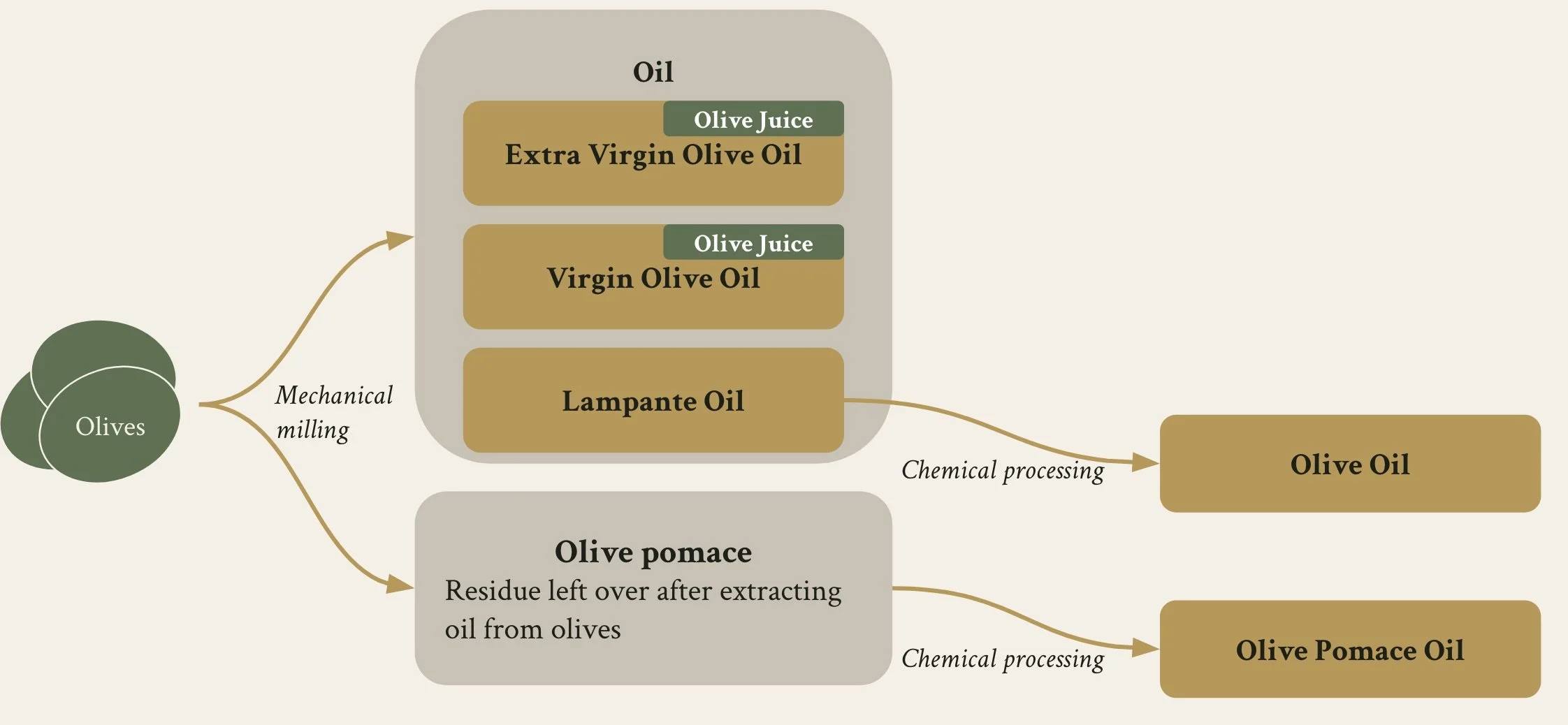
Olive oil: commercial categories. © 2026 longevoolive
Passing The Smell Test: Why Humans Still Taste Every Oil
EVOO is not defined by chemistry alone. By IOC standards, an extra virgin olive oil must meet objective chemical criteria - including free acidity lower than 0.8% - and subjective sensory criteria - meaning it must taste and smell a certain way.
This sensory evaluation is performed by tasting panels where olive oil experts assess positive attributes such as fruitiness - whether an oil smells and tastes like fruits and vegetables -, bitterness, and pungency - the peppery sensation that belies a high polyphenol content.
IOC regulations are equally clear about what should not be present. Defects - negative sensory attributes - include oils that smell or taste fusty, moldy, sour, rancid, or even metallic. The list of defects is longer, but these are the most common ones.
These defects can oftentimes be traced back to something gone awry at the time of harvesting, transportation, or processing, although some originate when the olives are still on the tree. Expert olive oil tasters can negative properties stemming from oxidation, contamination, fermentation, and even improper storage or poorly maintained processing equipment, just with a whiff and sip. If they detect even the slightest defect, the oil cannot be classified as extra virgin.
Lampante and Olive Oil
At the bottom of the spectrum sits lampante oil. Lampante is a virgin olive oil with severe defects and/or excessive acidity. Under IOC standards and regulations, it is not fit for human consumption.
Historically, it was used as fuel for oil lamps - hence the name. Today, lampante oil is sent to refineries, chemically corrected, and eventually blended and sold as plain olive oil.
Seeing Past The Label
Consider this your cheat sheet for the next time you find yourself standing in the olive oil aisle, staring at a wall of green glass or plastic (more on that later). Because not all olive oils are created equal, below is a clear breakdown of the commercial categories as defined by IOC standards and regulations: how they’re produced, what’s been preserved, what’s been lost, and what you’re actually bringing home.
Calling something olive juice is not romanticism. It is technical truth. And once you understand the difference, you’ll begin to taste it.
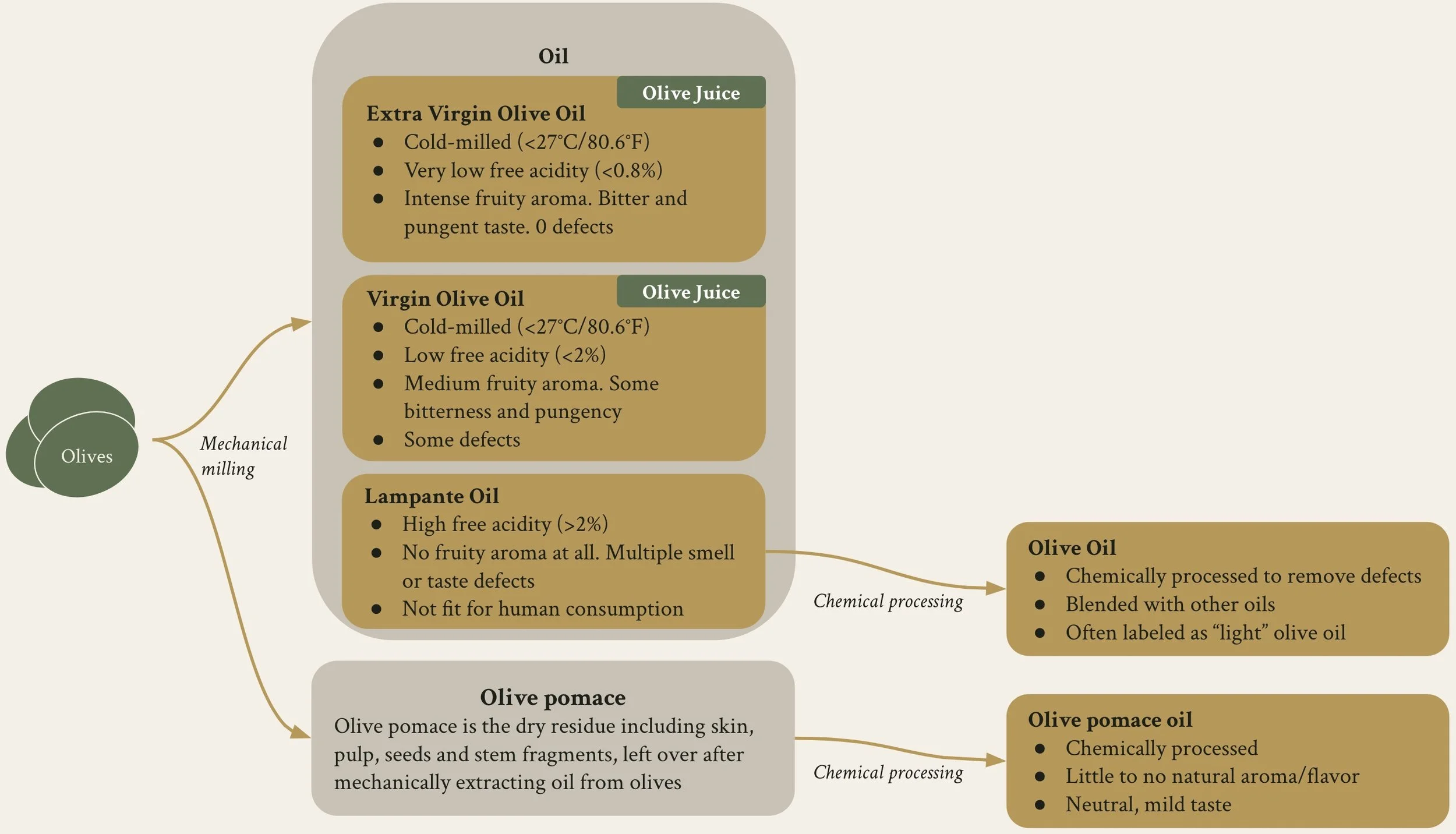
Olive oil: commercial categories and key characteristics. © 2026 longevoolive